

On the Origin of Species
Charles DarwinDarwin's own account of evolution by natural selection, written in 1859 for the general reader.
Twenty years of evidence in one argument
Charles Darwin came home in 1836 from the five-year voyage of HMS Beagle with notebooks full of questions about how species arise. He worked on them quietly for two decades, until a letter from Alfred Russel Wallace, who had reached a similar idea in the Malay Archipelago, pushed him to publish. On the Origin of Species appeared in London in November 1859. Darwin himself called it "one long argument".
What you will find inside
- variation under domestication: what pigeon fanciers, gardeners and farmers had already shown about inherited change;
- the struggle for existence, and natural selection as its consequence;
- the difficulties of the theory, which Darwin sets out himself before answering them: the eye, instinct, hybrids;
- the gaps in the geological record and the distribution of living things across continents and islands, the Galápagos among them;
- the closing recapitulation and its famous "entangled bank".
Science without equations
Darwin wrote for anyone willing to follow him, with no formulas and very little technical vocabulary. His examples come from farms, gardens, the seashore and his own experiments at Down House in Kent. It is a book to read slowly, a chapter at a time, and one that still repays a first-time reader today.
Details
- Author
- Charles Darwin (1809–1882)
- Genre
- Natural history
- First published
- 1859
- Original language
- English
- Period
- 19th century
- Shelves
- Natural Sciences
- Language
- English
- Format
- A5 (148 × 210 mm)
- Paper
- Cream, 90 gsm
- Binding
- Perfect bound
- Cover
- Softcover, matte finish
- ISBN
- 978-2-38795-906-5
- EAN
- 9782387959065
- Publisher
- Rémanence Library
Readers' reviews
Charles Darwin
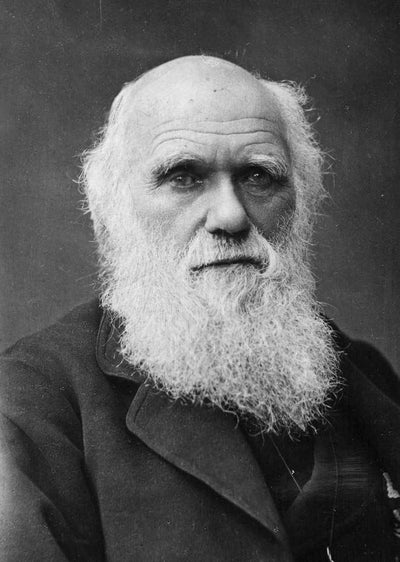
1809–1882
English
Charles Darwin was born in Shrewsbury in 1809, a grandson of the physician Erasmus Darwin and of the potter Josiah Wedgwood. He gave up medicine at Edinburgh, went up to Cambridge with a view to the Church, and in 1831 sailed as naturalist aboard HMS Beagle. The voyage lasted five years and took him round South America, to the Galápagos Islands and across the Pacific.
