

The Analects
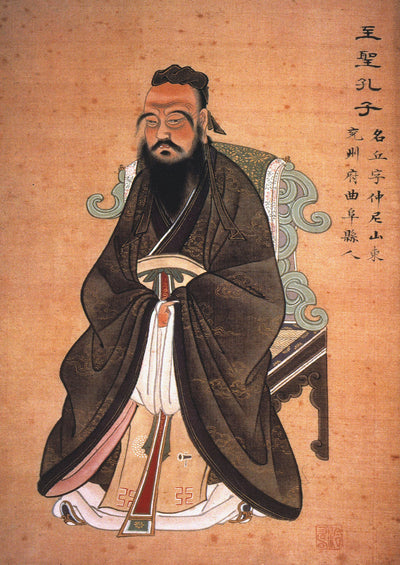
Confucius"The Master said" begins most of the sayings, and what follows is brief: a teacher answering a pupil, a remark about a ruler, a comment on a song.
A teacher without a court
Confucius, whose name was Kong Qiu, lived from 551 to 479 BC in a China divided among rival states. He held minor offices, travelled for years from one court to another looking for a prince who would put his ideas into practice, and found none. He returned home to teach. The Analects were compiled after his death by disciples and their followers, which is why the book reads as a mosaic, not an argument.
What the sayings are about
- the junzi, the gentleman, who is defined by conduct rather than by birth;
- ren, humaneness, the quality he found hardest to define and rarely claimed for anyone, himself included;
- learning as a lifelong pleasure, and ritual as the form that respect takes;
- government by example: if the ruler is upright, the people will follow.
Voices around the Master
Among the disciples are Yan Hui, whom the Master loved best for his quiet devotion, and the blunt, impulsive Zilu, whom he teased and corrected. Their questions and his replies give the book its warmth.
For centuries the Analects stood at the centre of Chinese education and the imperial examinations. This edition gives the English translation by James Legge (1861).
Details
- Author
- Confucius (-551–-479)
- Genre
- Collection of sayings
- First published
- c. 400 BC
- Original language
- Classical Chinese
- Translation
- James Legge (1861)
- Literary movement
- Confucianism
- Period
- Antiquity
- Shelves
- Philosophy
- Language
- English
- Format
- A5 (148 × 210 mm)
- Paper
- Cream, 90 gsm
- Binding
- Perfect bound
- Cover
- Softcover, matte finish
- ISBN
- 978-2-38795-656-9
- EAN
- 9782387956569
- Publisher
- Rémanence Library
Readers' reviews
Confucius
-551–-479
Chinese
Confucius lived in China in the sixth and fifth centuries BC, an age of small warring states, and he never held the high office he sought. Tradition places his birth in 551 BC in the state of Lu, and he is said to have worked as a minor official before spending years travelling from court to court in search of a ruler who would follow his advice.


