

Democracy in America – Volume II
Alexis de TocquevilleAlexis de Tocqueville was twenty-five when he first set foot in the United States in 1831, and by thirty-five he had explained to Europe what an equal society does to the people who live in it.
Why a prison inspector wrote political theory
Tocqueville and his friend Gustave de Beaumont had been given a modest commission: to report on American penitentiaries. They stayed nine months, travelled as far as the Michigan wilderness and the Mississippi, and questioned everyone who would talk. The result, published between 1835 and 1840, is one of the most searching studies of a nation ever written by a visitor.
Habits of the heart
The book looks at laws and institutions, but also at manners. Why do Americans form associations for every purpose? Why do they seem restless in the midst of comfort? Why does a democratic people prize the practical over the abstract, and what happens to art, language, religion and family life when ranks fall away? Tocqueville answers with close observation rather than theory, and he is careful to say what he admires and what he fears.
A warning and a hope
He saw that equality could lead either to liberty or to a gentle, all-managing servitude, and that the outcome depended on citizens themselves. He wrote as an aristocrat by birth who had accepted that the old order would not return. That mixture of sympathy and unease keeps the book alive for any reader curious about how free societies hold together, or fail to.
Details
- Author
- Alexis de Tocqueville (1805–1859)
- Genre
- Political and sociological treatise
- First published
- 1835, Paris
- Original language
- French
- Period
- 19th Century
- Shelves
- History, Human Sciences, Philosophy
- Volume
- II
- Language
- English
- Format
- A5 (148 × 210 mm)
- Paper
- Cream, 90 gsm
- Binding
- Perfect bound
- Cover
- Softcover, matte finish
- ISBN
- 979-10-453-1180-0
- EAN
- 9791045311800
- Publisher
- Rémanence Library
Readers' reviews
Alexis de Tocqueville
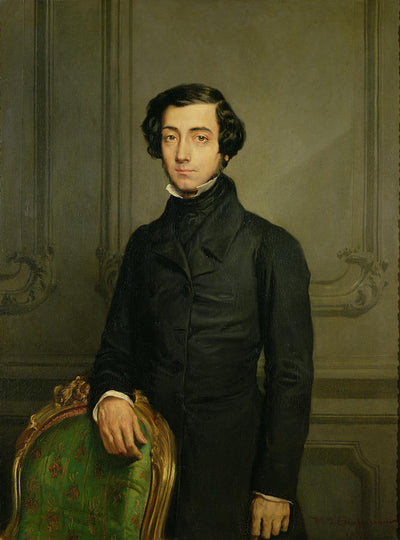
1805–1859
French
Alexis de Tocqueville travelled to the United States in 1831 with the official purpose of studying its prisons and returned with a political classic. Born in Paris in 1805 into an aristocratic Norman family, he trained as a magistrate and made the journey with his friend Gustave de Beaumont.


