

Atala
François-René de ChateaubriandBeside a fire in Louisiana, an old blind chief of the Natchez tells a young Frenchman how, as a prisoner condemned to be burned, he was freed by a stranger from the enemy camp.
The captive and the girl
The old man is Chactas; his listener is René, who has come to the New World to escape his own sorrows. Chactas recalls his youth: captured, led from village to village, saved on the eve of his execution by a young woman named Atala, who steals to his side at night and cuts his bonds. She is a Christian, and she is as frightened as he is. Together they flee into the forest.
A wilderness painted in words
François-René de Chateaubriand, who had travelled in America in 1791, saw the continent as a landscape of immense rivers, flowering magnolias, savannahs and great silences, and he described them in a rich, measured prose that French readers had not seen before. The two fugitives are sheltered by a missionary, Father Aubry, and the story of their love is bound to a vow that keeps them apart.
A short book with a long afterlife
First published in Paris in 1801, Atala made its young author famous, and he later folded it into The Genius of Christianity. Painters and composers took up its scenes throughout the century, and it remains the clearest early example of French Romanticism.
This edition gives the English translation by Caleb Bingham (1802).
Details
- Author
- François-René de Chateaubriand (1768–1848)
- Genre
- Romantic novella
- First published
- 1801, Paris
- Original language
- French
- Translation
- Caleb Bingham (1802)
- Literary movement
- Romanticism
- Period
- 19th Century
- Shelves
- Literature, Short Stories
- Language
- English
- Format
- A5 (148 × 210 mm)
- Paper
- Cream, 90 gsm
- Binding
- Perfect bound
- Cover
- Softcover, matte finish
- ISBN
- 978-2-38795-877-8
- EAN
- 9782387958778
- Publisher
- Rémanence Library
Readers' reviews
François-René de Chateaubriand
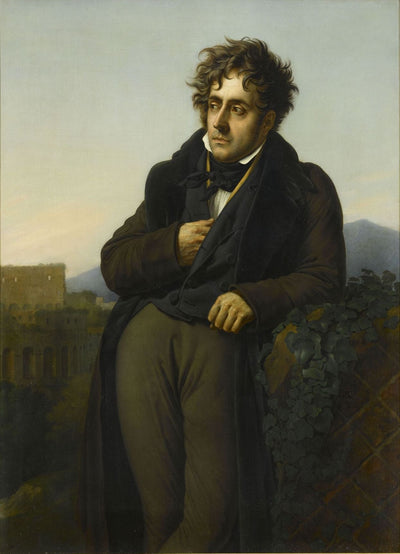
1768–1848
French
François-René de Chateaubriand spent his youth as a Breton aristocrat, then the French Revolution sent him across the Atlantic. Born at Saint-Malo in 1768, he travelled in North America in 1791 and returned to join the royalist army of émigrés, in which he was wounded. He spent the years from 1793 to 1800 in exile in England.


