

The Civil War
Julius CaesarIn January 49 BC a general with a single legion crossed a small river in northern Italy, and Rome was at war with itself.
Caesar tells it himself
Julius Caesar had been ordered by the Senate to give up his command. He refused, marched on Ariminum, and within about two months had driven Pompey and most of the Senate out of Italy. This is his own account of what followed, written in the third person, in the plain, rapid Latin of his Gallic War. He names his centurions, counts his cohorts and gives the reasons for every march. Whatever he says about himself, he says as a commander writing a report.
Spain, Marseilles, Africa, Greece
- the campaign against Pompey's lieutenants in Spain;
- the long siege of Massilia;
- the defeat of his officer Curio in Africa;
- the summer of 48 BC in Greece, ending on the plain of Pharsalus.
Pompey flees to Egypt and is murdered there. The narrative stops soon afterwards, at the start of the Alexandrian war.
An account written to be believed
Every reader has to weigh the author against the narrator: the book is a first-hand history of a civil war, and an argument that the other side began it. The English version here is by W. A. McDevitte and W. S. Bohn (1869).
Details
- Author
- Julius Caesar (-100–-44)
- Genre
- Historical commentary
- First published
- 1st century BC, Rome
- Original language
- Latin
- Translation
- W. A. McDevitte and W. S. Bohn (1869)
- Period
- Antiquity
- Shelves
- History
- Language
- English
- Format
- A5 (148 × 210 mm)
- Paper
- Cream, 90 gsm
- Binding
- Perfect bound
- Cover
- Softcover, matte finish
- ISBN
- 978-2-38795-683-5
- EAN
- 9782387956835
- Publisher
- Rémanence Library
Readers' reviews
Julius Caesar
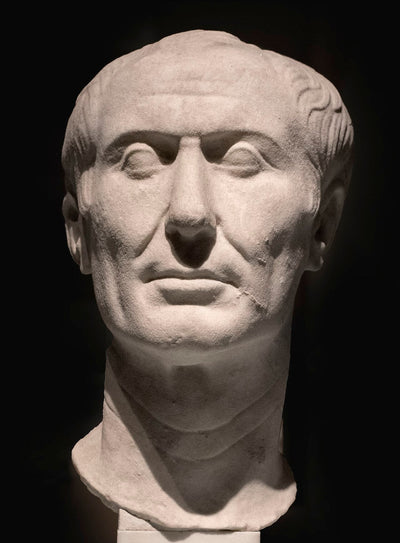
-100–-44
Roman
Julius Caesar wrote about his own campaigns in the third person, and with such plain, quick prose that schoolchildren have learned Latin from him for centuries. Born into an old patrician family in Rome in 100 BC, he rose through the offices of the Republic, served as consul in 59 BC, and then took the province of Gaul.


