

Hedda Gabler
Henrik IbsenHedda Tesman returns from a six-month honeymoon to a villa she chose herself, and within a few hours she has insulted her husband's aunt over a hat.
A house in Christiania
Henrik Ibsen opens the play on a morning in the drawing-room of the young couple's new house. Jørgen Tesman, a scholar who hopes for a professorship, is delighted with everything. Hedda, the daughter of General Gabler, is bored with him, with the house and with herself. Over four acts, in a single home, she receives her husband's rival Eilert Løvborg, a former admirer, and an old schoolfellow, Mrs Elvsted, as well as the smooth Judge Brack.
The General's pistols
In a case in the inner room lie the pistols that belonged to her father, and the audience is not told at once what they are for. Hedda wants a measure of freedom and power in a society that gives a woman neither, and she tries to find it by managing the lives of those around her. Ibsen does not make her a villain or a victim, and critics have disagreed about her ever since.
Published at the end of 1890
The play was published in Copenhagen in December 1890 and first staged in Munich in January 1891. Its drawing-room realism shocked the theatre-goers of the period, and it remains among the most performed plays of the modern stage. It repays reading as well as watching, because the stage directions describe the room and its objects with remarkable care.
Details
- Author
- Henrik Ibsen (1828–1906)
- Genre
- Play in four acts
- First published
- 1890, Copenhagen
- Original language
- Norwegian
- Literary movement
- Realism
- Period
- 19th Century
- Shelves
- Literature, Theatre
- Language
- English
- Format
- A5 (148 × 210 mm)
- Paper
- Cream, 90 gsm
- Binding
- Perfect bound
- Cover
- Softcover, matte finish
- ISBN
- 978-2-38794-297-5
- EAN
- 9782387942975
- Publisher
- Rémanence Library
Readers' reviews
Henrik Ibsen
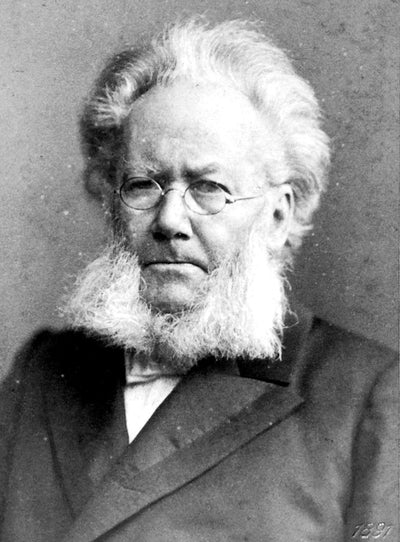
1828–1906
Norwegian
Henrik Ibsen left Norway in 1864 and did not live there again for twenty-seven years. Born in 1828 at Skien, he had worked as a chemist's apprentice before he turned to the theatre, and he spent his early career writing and directing plays in Bergen and Christiania.


