

A Study in Scarlet
Arthur Conan Doyle"You have been in Afghanistan, I perceive": with that sentence, in a London hospital laboratory, Sherlock Holmes meets Dr John Watson.
Rooms to share at 221B
Watson has come home from the war with a bullet wound, a small pension and nowhere to live. A friend tells him of a man who is looking for someone to share rooms. They take lodgings at 221B Baker Street, where Watson tries to understand his odd companion, who knows a great deal about poisons and nothing about the solar system, and who describes himself as a "consulting detective", a profession he says he invented.
A word on a wall in Brixton Road
Then Holmes is called to an empty house in Lauriston Gardens, where a well-dressed man lies dead without a wound, and on the wall behind him someone has written a single word in blood. Scotland Yard's men have their theories. Holmes crawls over the floor with a tape measure and a lens, and reaches different conclusions.
Where it began
Arthur Conan Doyle, then a young doctor in Southsea, published the story in Beeton's Christmas Annual in 1887, and it was issued as a book the following year. It is the first appearance of both men, and of the method that the later stories would make famous.
Details
- Author
- Arthur Conan Doyle (1859–1930)
- Genre
- Detective novel
- First published
- 1887, London
- Original language
- English
- Period
- 19th Century
- Shelves
- Literature, Novels
- Language
- English
- Format
- A5 (148 × 210 mm)
- Paper
- Cream, 90 gsm
- Binding
- Perfect bound
- Cover
- Softcover, matte finish
- ISBN
- 978-2-38795-663-7
- EAN
- 9782387956637
- Publisher
- Rémanence Library
Readers' reviews
Arthur Conan Doyle
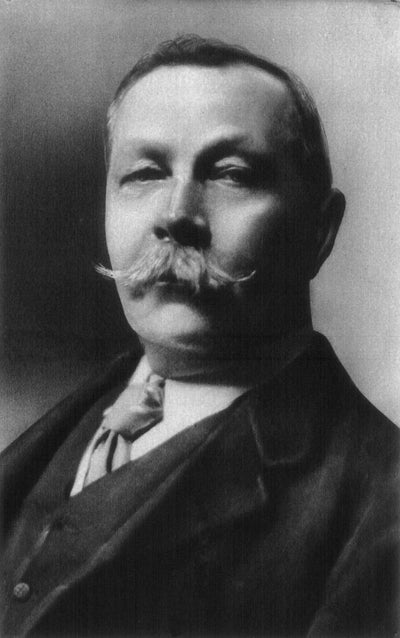
1859–1930
Scottish
Arthur Conan Doyle based Sherlock Holmes on a surgeon and teacher he admired, Joseph Bell of Edinburgh, and then tried more than once to be rid of the detective. Born in Edinburgh in 1859, he studied medicine there and practised as a doctor at Southsea, writing in the gaps between patients.


